Genomic Press · Now Publishing

Brain Health

Lifelong Brain Resilience and Longevity

The first journal dedicated to the science of sustaining, protecting, and optimizing brain function across the entire human lifespan. Not a journal of brain disease, and not a journal of mental health either. A journal of how brains stay well.

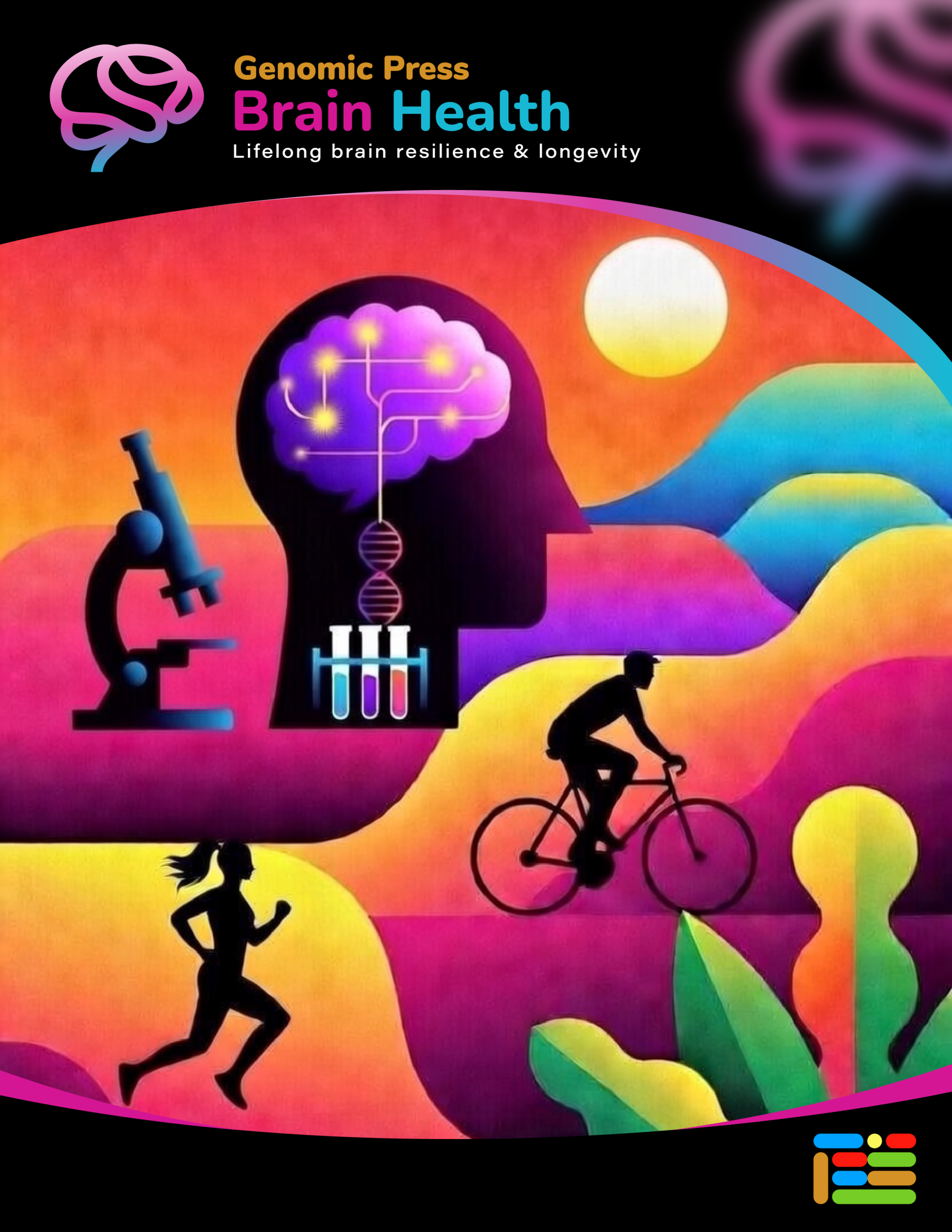
Brain Health journal cover, Genomic Press
Publishing Now

Now Publishing Online

Brain Health publishes articles online as soon as they are accepted and produced, with the online release date serving as the official publication date. The five articles below are live and citable now. They open the journal with the conviction that organizes its scope: brains are sustained as well as treated, and the science of how brains stay well deserves a dedicated venue.

Editorial

The astrocyte and the plastic spoon: Welcoming Brain Health, a journal of lifelong brain resilience

Ma-Li Wong

The inaugural editorial sets out what Brain Health intends to be and what it does not. The journal opens by holding two faces of brain resilience side by side: the astrocyte arriving late in adult life and weaving itself into hippocampal circuits, and the polymer leaving the bloodstream through clinical removal. Brain health, in this framing, is regenerative and corrective, additive and subtractive, and the journal will publish both.

Read →
Innovators & Ideas: Rising Star

Luisa Pinto: Rethinking depression through the lens of neuron-glia plasticity

Luisa Alexandra Meireles Pinto

A Genomic Press Interview with Luisa Pinto, principal investigator at the Life and Health Sciences Research Institute, University of Minho. Pinto traces her path from stem-cell work at the Karolinska Institute through doctoral training with Magdalena Götz to an independent program centered on adult hippocampal cytogenesis. Her finding that newborn astrocytes, alongside newborn neurons, are required for sustained remission from depressive-like states reframed a literature long focused on neurons alone.

Read →
Perspective

The human microplastic burden and brain health: From measurement to pathophysiology and removal

Licinio J, Steenblock C, Fabiano N, Bornstein SR, Wong M-L

A Perspective on what is now measurable, what is not, and what the field must do next. Decedent human brain tissue carries microplastic concentrations seven to thirty times higher than liver or kidney, with the heaviest loads in donors with dementia. Ultra-processed foods are the principal delivery vehicle. The authors argue that population-scale exposure reduction, polymer-specific risk stratification, and clinical removal strategies including therapeutic apheresis define the immediate research agenda.

Read →
Viewpoint

From lesions to brain health: Causal circuits in psychiatry

Cotovio G, Oliveira-Maia AJ

A Viewpoint on what causal network mapping reveals about psychiatric disorders. Across depression, mania, psychosis, post-traumatic stress disorder, addiction, and obsessive-compulsive disorder, lesions, deep brain stimulation targets, and transcranial magnetic stimulation targets converge on shared circuits. The authors argue that brain health is best understood as the capacity of distributed networks to sustain adaptive regulation of emotion, cognition, and behavior, and that perturbation studies offer the strongest available causal evidence in human neuroscience.

Read →
Obituary

In memory of J. Craig Venter (1946-2026): The scientist who dared challenge the impossible and won

Julio Licinio

Brain Health remembers J. Craig Venter, who died on 29 April 2026. The obituary traces his career across genomics, synthetic biology, and ocean science: the first complete genome of a free-living organism, the parallel pursuit of the human sequence, the global ocean expedition, the construction of the first synthetic cell, and his sustained advocacy for ocean health and the removal of plastic from the seas. Word impossible appeared often in his career, almost always coming from someone else, who was subsequently proved wrong.

Read →
Brain Health Is Not Mental Health

The phrase "mental health" has become a polite circumlocution for mental illness. Brain health is a fundamentally different proposition.

It begins not with disease but with the intact, functioning organ and asks what sustains that function, what threatens it, and what restores it when it falters.

🧠

Brain Medicine

Spans the full landscape of brain disorders from origins to treatment. Its lens encompasses neurology, psychiatry, neurosurgery, and all clinical brain disciplines organized around pathology, diagnosis, and intervention.

Brain Health

Trained on the conditions, mechanisms, and interventions that keep brains working well. Rooted in resilience, in the biology of cognitive and emotional vitality, and in the conviction that understanding how brains remain well is as necessary as understanding how they become ill.

From Molecules to Populations

Brain Health publishes across the full methodological range, united by a single organizing question: how do brains remain resilient, and how can that resilience be sustained and restored?

🧬

Molecular & Cellular

Neural resilience mechanisms, synaptic maintenance, neuroprotective pathways, genomics, and proteomics of brain health.

Neuroplasticity & Recovery

Cognitive reserve, functional restoration, neurogenesis, and the neurobiology of how brains weather insults that devastate others.

🫀

Vascular & Metabolic

Cerebrovascular contributions to brain health, metabolic regulation, immune surveillance, and the gut-brain axis.

🛌

Sleep & Lifestyle

Sleep neuroscience, nutritional neuroscience, exercise science, and behavioral interventions for cognitive longevity.

📊

Epidemiology & Digital Health

Population-level cognitive trajectories, modifiable risk factors, computational modeling, and digital health technologies.

🏛️

Policy & Public Health

Brain health as public policy, lifespan strategies for cognitive preservation, and the social and behavioral determinants of brain resilience.

Editor-in-Chief

Brain Health is led by Ma-Li Wong, MD, PhD, whose four-decade career bridging neurology, psychiatry, neuroendocrinology, immunology, and genomics across four continents embodies the integrative vision the journal seeks to advance.

Ma-Li Wong
MD · PhD
Editor-in-Chief
Brain Health
Genomic Press
300+
Publications
25,500+
Citations
73
h-index

Bridging neurology, psychiatry, and genomics across four continents

Trained as both a neurologist and psychiatrist, Dr. Wong completed her medical degree at the University of São Paulo, with residencies in internal medicine and neurology at USP, a psychiatry residency at Albert Einstein College of Medicine and Montefiore Medical Center, a neuroendocrinology fellowship at the National Institute of Mental Health, and a chief residency at Yale. She earned her PhD from Flinders University in Australia. Her faculty appointments have spanned Yale, the NIH Clinical Center, UCLA, the University of Miami, the Australian National University, the South Australian Health and Medical Research Institute, Flinders University, and SUNY Upstate Medical University, and she holds visiting professorships in China.

Her research program spans pharmacogenomics, neuroimmunology, and neuroendocrinology, including the first NIH-funded studies of antidepressant pharmacogenomics in Hispanic populations, foundational work on cytokine biology and the inflammasome in depression, and the discovery of the pulsatile secretion and circadian regulation of human leptin.

Read full biography

Eminent International Experts

Brain Health is supported by an editorial board of internationally recognized researchers spanning seven countries and four continents, with expertise across the full spectrum of brain health science from molecular resilience to population health.

Haitham Amal
Hebrew University of Jerusalem, Israel, and Boston Children's Hospital, Harvard Medical School, Boston, Massachusetts, USA
Najaf Amin
University of Oxford, Oxford, UK
Tatiana Barichello
The University of Texas Health Science Center at Houston, Texas, USA
Emiliana Borrelli
University of California, Irvine, California, USA
Harris Eyre
Global Brain Economy Initiative and Rice University, Houston, Texas, USA
Nicholas Fabiano
University of Ottawa, Ottawa, Ontario, Canada
Julio Licinio
SUNY Upstate Medical University, Syracuse, New York, USA
Yvonne Nolan
University College Cork, Ireland
Christos Pantelis
The University of Melbourne, Melbourne, Victoria, Australia
Luisa Pinto
University of Minho, Braga, Portugal
Vitaly Ryu
Icahn School of Medicine at Mount Sinai, New York, USA
Zoltan Sarnyai
James Cook University, Townsville, Queensland, Australia
Mayana Zatz
Universidade de São Paulo, São Paulo, Brazil

Why Brain Health

Brain Health treats peer review as a scientific collaboration, not a bureaucratic checkpoint. Authors receive personalized, rapid review, full Open Access under CC BY 4.0, equitable publication costs, and global media dissemination at no additional cost.

Personalized, Rapid Review

Manuscripts are handled directly by the Editor-in-Chief and an international editorial board of leading experts. Submissions are routed to eight scholars from different countries with a target of at least three independent critiques. Initial editorial decisions typically arrive within two to four weeks.

🌐

Global Press Coverage

Every newsworthy paper receives a professionally written press release distributed in seven languages through EurekAlert! at AAAS, EIN Presswire, and major AI databases including ChatGPT, Gemini, and Perplexity. All press fees are covered by Genomic Press at no cost to authors.

🔓

Full Open Access

All articles publish under CC BY 4.0 with immediate, unrestricted worldwide access. Authors retain copyright. Content is preserved in perpetuity through Portico. No embargoes, no paywalls, no restrictions on legitimate reuse.

⚖️

Fair Cost Structure

Article processing charges are fully waived for authors from World Bank-classified low-income countries, with automatic 50 percent discounts for lower middle-income countries with GDP below 200 billion USD. Additional waivers are considered on an individual basis.

Global Dissemination Infrastructure

Genomic Press has built a dissemination infrastructure that no other comparable publisher matches, included with every publication at no additional cost. Across our four journals in slightly over one year, this infrastructure has generated documented global reach measured in billions.

6,000+
News Stories
50+
Languages
6B+
Media Reach
1 Year
Track Record

EurekAlert! at AAAS

Press releases distributed in English plus six additional languages including French, Spanish, Mandarin Chinese, Portuguese, German, and Japanese, reaching journalists at Nature, Science, the New York Times, the BBC, Reuters, and hundreds of major outlets.

EIN Presswire

Distribution across AP News, Google News, Yahoo News, Bing News, Bloomberg Terminal, plus major AI databases including ChatGPT, Gemini, and Perplexity, with country-specific newswires activated based on author location.

Two Lenses, One Conviction

Brain Health and Brain Medicine share a conviction that brain science must be integrative and translational. The overlap between them is a strength, not a redundancy.

Established

Brain Medicine

The full landscape of brain disorders: from molecular origins to clinical treatment, spanning neurology, psychiatry, neurosurgery, radiology, ophthalmology, and otology. Featured in The New York Times, The Washington Post, Nature, and 6,000 plus news stories worldwide.


Visit Brain Medicine →
Now Publishing

Brain Health

The science of sustaining and optimizing brain function throughout life. Neural resilience, cognitive vitality, neuroprotection, and the conditions under which brains thrive from childhood through aging. A fundamentally different starting point: the intact, working organ.


Submit to Brain Health →

Some studies speak naturally to both journals. We encourage authors to choose
the venue whose emphasis best fits the framing of their work.

Open Access, Academic-Driven

True Open Access

Every article is immediately and permanently free to readers worldwide. No embargoes, no paywalls, no restrictions on legitimate reuse. Published under Creative Commons Attribution 4.0 International, CC BY 4.0. Authors retain copyright. Content is preserved in perpetuity through Portico.

🔓 CC BY 4.0 · Open Access

2026 Launch Promotion

Genomic Press is owned and operated by academics, for academics. Surplus revenues are reinvested in journal development, not extracted as profits.

No Publication Charges

For the entire 2026 launch year, all article processing charges are waived. Publish your research in Brain Health at no cost.

Standard rates resume in 2027, with full waivers for low-income countries and 50 percent discounts for lower middle-income countries with GDP under 200 billion USD. Additional waivers are considered on an individual basis. Genomic Press remains committed to keeping publication accessible to researchers regardless of funding levels.

Your Research Begins Here

How do we keep our brains working well, for as long as possible? If your work addresses that question, Brain Health is your home.